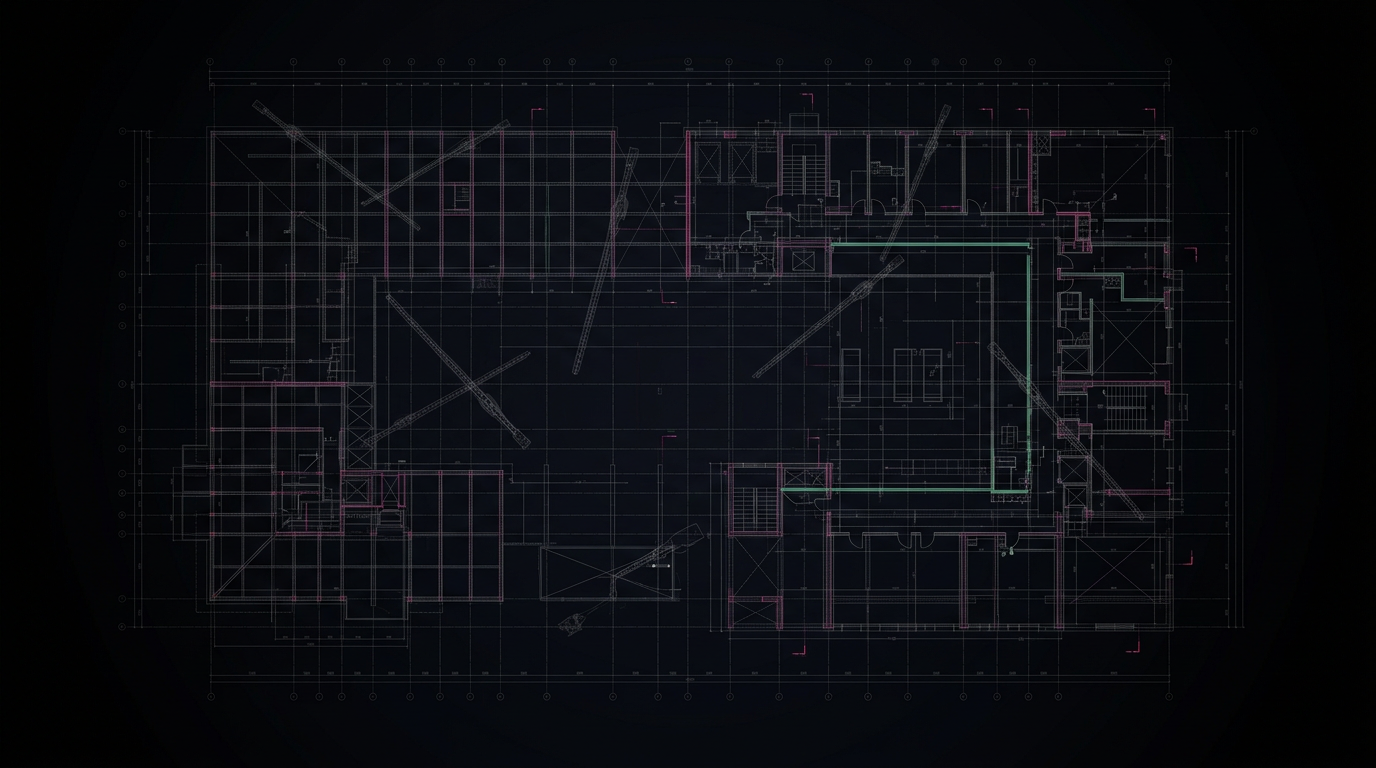
Janus Edilizia orchestrates orders, people, suppliers, deadlines, and documents in a single connected architecture. Construction site control no longer lives only in someone's memory.
Where they are open, where they are concentrated, what status they are in: this is the map view of the Construction Sites module. Preview with demo data.
Excel quotes, photos on WhatsApp, deadlines kept in your head, documents scattered in different folders. The problem isn't the individual tool: it's the fragmentation.
Progress reports, supplies, permits: everything holds up as long as someone remembers it.
The site photo is on someone's phone. The quote is in another version.
What is the status of the construction site? What are the suppliers missing? No one knows for sure.
The tools remain. The way they communicate changes: every piece of information enters once and reaches the right job order.
Non è un'illustrazione: nodi e collegamenti sono i moduli e le relazioni dichiarate nel DNA di questo verticale. Ogni cantiere vive su questa mappa.
A real flow, from event to outcome. People intervene where judgment is needed — Janus handles everything else.
Teams, processes, vehicles, materials, and documents coordinated by construction site. The complete picture, always.
Information is searched for in one place: every piece of data is linked to the job order, not scattered across phones and folders.
From the accepted quote, the construction site and order are automatically generated; the invoice inherits the lines with locked prices.
Contracts, transport documents (DDT), building permits, and policies in an AES-256 encrypted Vault; PSC and POS are triggered when multiple companies are on-site.
Quick responses, polished quotes, documents always in order: an organized business acquires better.
More orders don't mean proportionally more chaos: processes remain orchestrated as volume increases.
SAMI welcomes the client to the site and opens the request; JANUS is the management software's voice assistant: it queries sites, clients, quotes, and schedules. Information no longer depends on who answers the phone.
Contracts, quotes, and customer data are the company's assets. Janus protects them by design, not as an afterthought.
Access is via private key: the keystore unlocks on the device, never on the server.
Owner, technical management, administration, site manager, worker: read and write matrices applied by the server.
Documents and contracts encrypted on the device, with the key wrapped for each recipient.
Clock in with a QR code that lasts five seconds or within the site's GPS geofence: the position is captured only at that moment, never continuously.
The Janus core is written in Go: a single compiled binary, with no external services to orchestrate, featuring an in-process database and real-time channel. Fewer layers to keep running means fewer resources committed for the same amount of work.
The local-first runtime works even where there is no connection — on-site as well as in the office — and every new process is added via configuration, without redesigning the system.
Janus doesn't promise revenue: it removes the work that doesn't produce it. Fewer unproductive hours create the conditions for higher margins and more contracts, without increasing complexity in the same proportion.
Less administration, less time spent searching for information.
The same people manage more construction sites, with less friction.
Streamlined processes and rapid responses: increased acquisition capacity.
Fewer unproductive hours per site: conditions for higher profitability.
Scale your projects without scaling the chaos.
No made-up percentages: site hours come from clock-ins and progress from the share of completed tasks, never from elapsed time. During the demo, we measure it based on your specific case.
Direct answers for those choosing their business software: what Janus Edilizia actually does, how it works, and where to start.
The most suitable management software for a construction company covers the entire project without re-typing, and Janus Edilizia was born for this: the client request becomes a quote, the accepted quote opens the site — client, paperwork, safety, team, and dates — and the invoice inherits the client and frozen lines from the quote, or the progress share from the Work Progress Report (SAL). Every step remains linked to the previous one, from first contact to payment collection.
Yes. In the Janus Edilizia quote editor, the company's internal price list and the regional price list are searched together, and every line displays a badge indicating its origin: the commercial "turnkey" price coexists with the official analytical item that justifies it, complete with the labor share for each individual entry. Prices are frozen within the quote: subsequent editions of the price list will not affect them.
With Janus Edilizia, the construction site is born from the accepted quote: its line items become the work checklist and the basis for the Progress Report (SAL). Progress is the share of completed tasks weighted by amount, never just elapsed time, and hours per job come directly from site clock-ins. From there, down payment, progress, and final invoices inherit the completion percentage without re-entering any data.
With Janus Edilizia, attendance is monitored via phone: the worker clocks in, records breaks, and clocks out, and every entry provides proof of how it was made — dynamic QR on the entrance tablet, GPS within the site perimeter, or NFC badge. The server certifies it with its own clock and makes it non-rewritable: it is the official record for hours worked and payroll.
The Janus Site Diary is the project's work log: dated entries — notes, photos, weather, progress, equipment and material deliveries — written by those on-site as they happen. Each entry carries its author and a server-signed certification that freezes it: from that point, it cannot be modified or deleted, remaining a legible record for the client and site management months later.
The financial proposal is built around the company profile — people, active sites, required modules — so we do not publish a single price list. The process starts with a guided demo based on your real-world case: you see the complete flow, from request to quote to invoice, using your scenarios. From the page, you can book the demo and receive a calibrated proposal, with no obligation.
Yes: jobs, quotes, and documents live in an installation dedicated to your company and remain your property. The architecture is local-first, so you can work on-site even without a signal, and the exit strategy is addressed during the demo, before you even sign up: no hidden lock-ins.
Get started quickly because the Construction vertical comes pre-configured: modules, operational roles — from the owner to the site manager to the worker — and work lists are built into the system's DNA, and the service catalog arrives with base tasks ready to be adapted to your prices. Records, vehicles, and equipment are registered in their respective modules; for historical data, the import path is defined together during the startup phase.
Janus doesn't add another piece of software: it connects and orchestrates what already makes it work.